



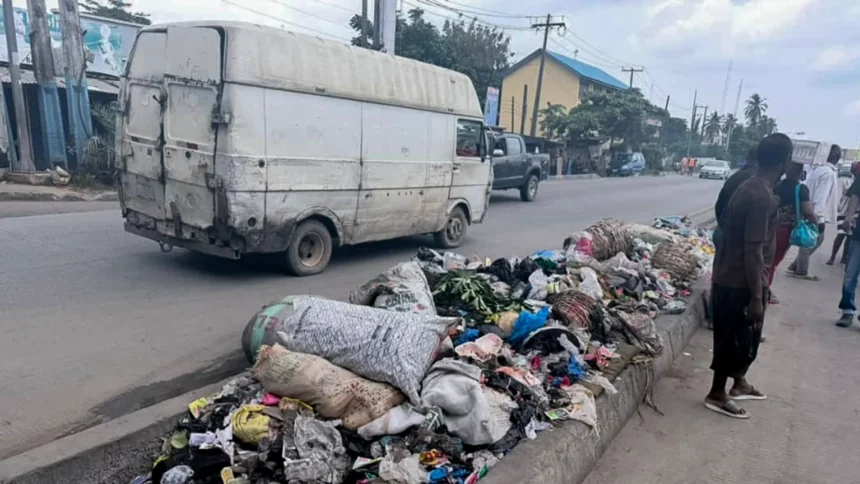
Residents across Lagos State have raised concerns over worsening waste accumulation in several communities, warning that the situation could trigger public health challenges if urgent action is not taken.Many residents said they are struggling with the persistent stench from overflowing refuse dumps, while heaps of uncollected waste have become a common sight along roads, markets, bus stops and major highways across the state.
From Mushin and Agege to Ajah, Oshodi, Ajegunle, Iyana Ipaja, Abule Egba, Lekki and Okota, growing piles of waste have transformed public spaces into informal dumping grounds, highlighting mounting pressure on the city’s waste management system.Residents also complained that waste collection services provided by Private Sector Participants (PSPs) have become increasingly irregular, with some households reporting that refuse bins have remained unattended for weeks despite regular payments.
According to several residents, the situation has been worsened by heavy rainfall, which has clogged drainage systems with waste materials, leading to flooding, environmental hazards and concerns about the spread of disease. Some PSP operators have reportedly attributed delays in waste evacuation to operational challenges at disposal sites, particularly the Olusosun dumpsite, where adverse weather conditions have slowed truck movement and increased turnaround times.
In response to the concerns, the Lagos Waste Management Authority (LAWMA) said it remains committed to improving waste collection and sanitation services across the state. LAWMA Managing Director and Chief Executive Officer, Dr Muyiwa Gbadegesin, disclosed that the agency and its licensed PSP operators evacuated approximately 418,500 tonnes of waste in May 2026, averaging about 13,200 tonnes daily.
He noted that 442 PSP operators are currently active across Lagos, while several collection routes are undergoing review to improve service coverage and operational efficiency. The agency also reported clearing 173 waste black spots during the month in markets, road medians, bus stops and other public locations. Gbadegesin explained that persistent rainfall and increased waste volumes have placed significant strain on disposal infrastructure, affecting landfill operations, truck movement and waste evacuation logistics throughout the state.
He added that LAWMA is implementing measures such as route optimisation, enhanced monitoring of PSP operations, infrastructure upgrades, equipment deployment and stricter enforcement against indiscriminate waste disposal to address the challenges. Environmental expert and Group Managing Director of Brightest Hope Group, Dr Omowunmi Olatunji, acknowledged LAWMA’s efforts but noted that Lagos’ rapidly growing population continues to place enormous pressure on existing waste management infrastructure.
According to her, key challenges include inadequate waste segregation, illegal dumping, insufficient collection coverage in some densely populated areas, ageing infrastructure and population growth that is outpacing service expansion. Olatunji called for a more comprehensive approach to waste management, including mandatory waste separation at source, increased investment in recycling and waste-to-energy facilities, stronger enforcement against environmental violations and the adoption of modern technology to improve operational efficiency.
She stressed that Lagos’ waste challenge extends beyond sanitation and has implications for public health, environmental sustainability, climate resilience and economic development. According to her, achieving lasting solutions will require stronger collaboration between government agencies, private operators, communities and residents, alongside a transition to a more sustainable circular economy model.
Source: https://guardian.ng/