



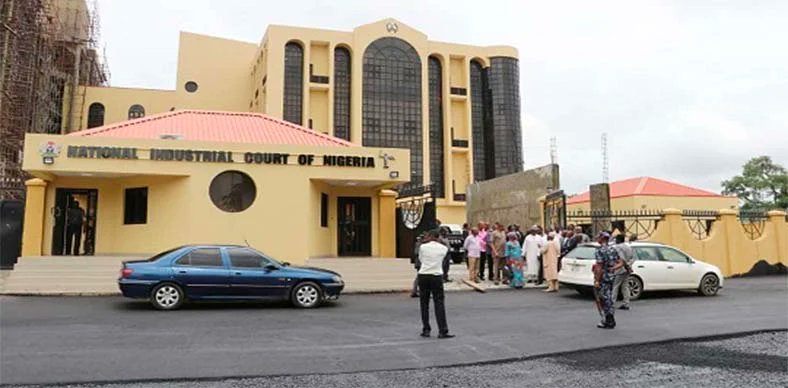
The National Industrial Court on Monday barred workers organised under the Nigerian Labour Congress and the Trade Union Congress from proceeding with a planned mass protest scheduled for Tuesday or any other date.Justice Emmanuel Sibilim issued the interim order while ruling on an ex parte application filed by the Minister of the Federal Capital Territory, Nyesom Wike, and the Federal Capital Territory Administration against the labour unions and their officials.
According to the News Agency of Nigeria, those listed alongside the NLC and TUC in the suit include Comrades Benson Upah, General N. A. Toro and Stephen Knabayi. The application, dated February 2, arose from a suit marked NICN/ABJ/30/26, filed by James Onoja, SAN, on behalf of the minister and the FCTA. After hearing submissions from the claimants, Justice Sibilim granted an interim injunction restraining the first to fifth respondents, as well as their agents or representatives, from embarking on any strike action pending the hearing and determination of the motion on notice.
The court further directed the fifth to ninth defendants, who are security agencies, to ensure that law and order are maintained. The matter was adjourned to February 10 for the hearing of the motion on notice. The claimants informed the court that the chairman of the FCT workers’ union had circulated a mobilisation message to union members and affiliates for a mass protest slated for February 3, an action their lawyer said violated an earlier court order. Onoja told the court that following its ruling on January 27, the order was served on the defendants the same day. Despite this, he said the NLC and TUC issued a statement instructing affiliated unions to intensify and sustain the strike.
The statement, jointly signed by both unions, reportedly directed striking workers to continue the industrial action, citing the filing of an appeal by their counsel, Femi Falana, SAN, against the interlocutory ruling. He added that, in response, FCTA workers operating under the Joint Union Action Committee issued a circular directing all employees to maintain the strike. Onoja argued that the actions were capable of causing a breakdown of law and order in the nation’s capital. Y⁵he minister and the FCTA based their application on the claim that on January 19, workers employed by the second claimant, acting through the Joint Union Action Committee, commenced an industrial action by shutting all entrances to offices and the FCTA secretariat.The action, he said, also led to the closure of schools and other departments and agencies of the FCTA, effectively paralysing government activities and bringing the functions of the claimants to a halt.
Source: https://theeagleonline.com.ng/