




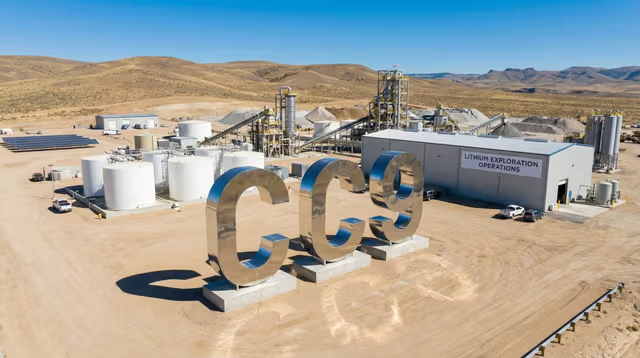
Australian mining firm Chariot Resources Limited has announced the discovery of lithium-rich minerals in Nigeria following the approval of six mining licences by the Nigerian Mining Cadastre Office, marking a major step into the country’s growing critical minerals sector. The approved licences, which include four exploration permits and two small-scale mining licences, were transferred from Continental Lithium Limited to C&C Minerals Limited, Chariot’s Nigerian joint venture. This move strengthens the company’s control over key projects in the region.
The licences cover exploration activities at the Fonlo and Gbugbu sites, along with small-scale mining operations at the Saki project, effectively consolidating Chariot’s presence across strategic lithium assets. According to the company’s Executive Chairman and Managing Director, Shanthar Pathmanathan, the approvals represent a significant milestone, positioning Chariot as the first ASX-listed lithium firm to enter Nigeria’s emerging lithium market. He noted that the country hosts lithium-bearing pegmatites already supplying spodumene to China, despite limited exploration.
The development also advances Chariot’s plan to acquire a 66.667 percent stake in C&C Minerals, while Continental Lithium will retain the remaining 33.333 percent. Described as a key regulatory breakthrough, the approvals significantly reduce risks associated with the company’s Nigerian lithium portfolio. Meanwhile, four additional licences—three linked to the Saki project and one at Iganna—are still awaiting final approval.
Independent testing by the University of British Columbia confirmed the presence of high-grade spodumene across sampled sites at the Fonlo and Iganna projects. The mineral made up between 28.4 percent and 75.3 percent of the crystalline structure in the samples, indicating strong commercial potential. Lithium oxide grades recorded from the samples ranged between 2.66 percent and 5.96 percent, further supporting expectations of high-quality mineral deposits.
The analysis also revealed elevated levels of caesium, with pollucite concentrations reaching up to 9.5 percent in one Iganna sample, pointing to significant lithium-caesium-tantalum pegmatite potential. Chariot stated that the findings will help fast-track exploration efforts, guide future drilling activities, and support small-scale mining plans as it progresses toward phased development of its Nigerian projects.