



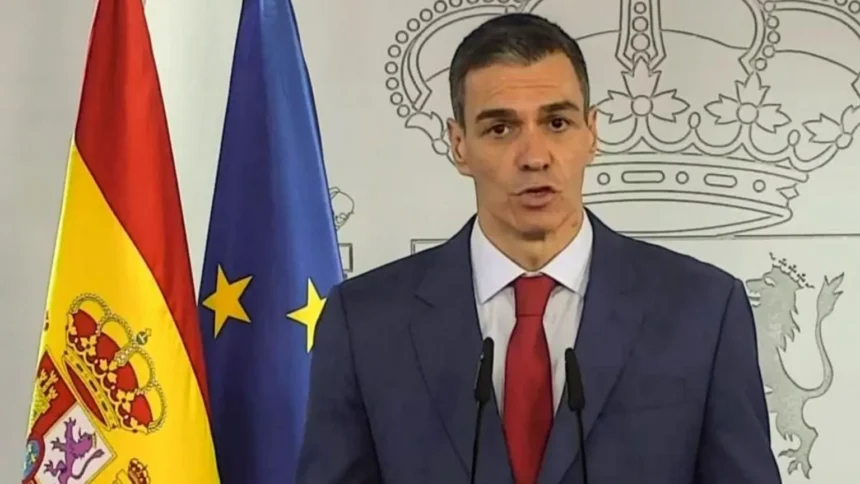
Spain’s Prime Minister Pedro Sánchez has strongly pushed back against US President Donald Trump’s threat to cut trade ties with Spain, reaffirming his government’s opposition to war and warning against what he described as a breakdown of international law.In a 10-minute televised address, Sánchez reflected on conflicts in Ukraine and Gaza as well as the Iraq War more than two decades ago, saying Spain’s position could be clearly summed up as “no to war.”Trump had earlier threatened to impose a complete trade embargo on Spain after Madrid refused to allow the United States to use the jointly operated military bases at Morón and Rota to launch strikes against Iran.Speaking during a meeting with German Chancellor Friedrich Merz on Tuesday, Trump criticised Spain sharply, describing the country as a poor partner and warning that Washington could end all trade relations with it.Merz later said he made it clear to Trump that separate trade agreements excluding Spain would not be possible with Germany or with the wider European Union.Following the US threat, France expressed support for Spain. The Élysée Palace said President Emmanuel Macron conveyed his solidarity with Sánchez during a phone call on Wednesday.European Council President António Costa also said he had spoken with the Spanish leader to express the European Union’s full support.Trump had also accused Spain of failing to meet NATO expectations by not increasing its defence spending to the alliance’s target of five percent of gross domestic product.Earlier in the year, tensions between Washington and Madrid had already grown after Sánchez criticised the United States over its military intervention in Venezuela.In his televised speech from the prime minister’s official residence in Madrid, Sánchez said the government was examining economic measures to protect Spaniards from the potential consequences of the conflict, though he did not directly mention Trump’s trade threat.He stressed that the issue was not about supporting Iran’s clerical leadership but about defending peace and international law. According to Sánchez, responding to one illegal act with another could lead to catastrophic consequences.The Spanish leader said the government’s approach toward Iran mirrored its stance on the conflicts in Ukraine and Gaza. Sánchez has been one of the strongest critics of Israel’s military campaign following the Hamas attacks in 2023.Spain has taken one of the most outspoken positions in Europe on the Gaza war, accusing Israel of committing genocide and recognising a Palestinian state earlier than many other EU countries.This position aligns with the views of Sánchez’s left-leaning coalition partners and broadly reflects Spanish public opinion on Middle East issues.Looking back at the US-led invasion of Iraq in 2003, Sánchez argued that the war had failed to achieve its goals and had ultimately worsened conditions for ordinary people. He warned that military action against Iran could similarly have severe economic consequences for millions.His reference to the Iraq War resonates strongly in Spain, where the conservative government of the People’s Party supported the invasion despite widespread public opposition and massive anti-war demonstrations.Many analysts believe that decision contributed to the Socialist Party’s unexpected election victory in March 2004, which came shortly after deadly jihadist bombings in Madrid.Sánchez also referred to the so-called “Azores trio” meeting before the Iraq invasion, involving then-US President George W Bush, UK Prime Minister Tony Blair, and Spain’s conservative leader José María Aznar at a Portuguese base in the Azores.He argued that the decision taken at the meeting left Europeans with a more insecure world and a worse quality of life.Sánchez’s position contrasts with that of Germany’s Chancellor Merz, who said in a television interview that regime change in Iran could ultimately make the world safer, though he acknowledged the risks and potential consequences involved.Unlike some NATO allies such as the United Kingdom, France and Greece, Spain has not committed to any military involvement in the current conflict.Meanwhile, White House press secretary Karoline Leavitt claimed that Spain had agreed to cooperate with the US military after hearing Trump’s warning.Spain’s foreign minister José Manuel Albares firmly rejected that claim, telling local media that his government’s position had not changed at all.Domestically, Sánchez has also been under heavy political pressure in recent months, with persistent speculation that his coalition government could collapse.The administration has struggled to maintain its parliamentary majority, which depends on support from several left-wing and regional nationalist parties.Allegations of corruption involving some of Sánchez’s allies and members of his inner circle have further weakened his position.Spain’s highly polarised political climate means that support for Sánchez often stems as much from opposition to right-wing and far-right parties as from approval of his leadership.However, confronting Trump could provide some political advantages. A recent survey by the CIS research institute found that 77 percent of Spaniards hold a negative opinion of the US president, suggesting Sánchez may receive support across political lines on this issue.Even so, uncertainty remains over whether Trump will follow through with economic measures against Spain, leaving many in the country watching the situation closely.
Source: https://www.bbc.com/