



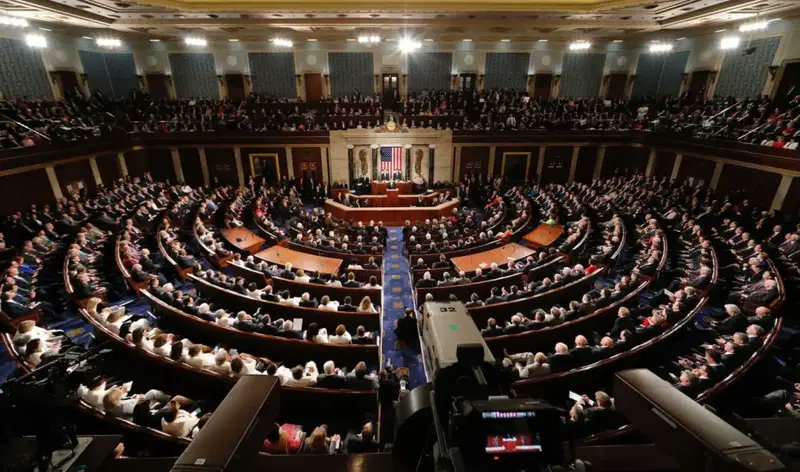
A hearing of the United States Congress on global religious freedom has criticised Nigeria’s reported $9 million lobbying agreement in Washington, with lawmakers cautioning that the deal appears intended to minimise serious claims of human rights abuses and violations of religious freedom. The issue was discussed on Wednesday at a joint session of the House subcommittee on Africa and the subcommittee on the western hemisphere, held under the theme Defending Religious Freedom Around the World.According to Punch, the hearing featured testimonies from Sam Brownback, a former US ambassador-at-large for international religious freedom, and Stephen Schneck, a former chairman of the US Commission on International Religious Freedom.
The chair of the House foreign affairs Africa subcommittee, Chris Smith, justified the October 2025 decision to list Nigeria as a Country of Particular Concern under the International Religious Freedom Act, describing the move as long overdue after years of deadly attacks on Christian communities. Smith said he was troubled by what he characterised as attempts to undermine the designation through heavy lobbying efforts. “I want to tell my colleagues that I am deeply worried that Nigeria has engaged the lobbying firm, DCI Group, at a cost of $9 million, or $750,000 every month,” he said.
He further disclosed that a Nigerian billionaire had entered into a separate agreement valued at $120,000 per month with Washington-based consultancy firm Valcour, aimed at influencing both Congress and the executive branch. “They bring in these firms, which then roll out polished talking points suggesting there is nothing to worry about,” Smith said, lamenting what he described as the ability of lobbyists to dilute perceptions of persecution and violence. While Smith argued that the CPC designation was necessary to pressure the Nigerian government, the ranking member of the committee, Sara Jacobs, faulted what she saw as an overly narrow emphasis on Christian persecution, cautioning against simplistic interpretations of the crisis.
Jacobs pointed out that despite stated concerns over religious violence, the US government had reduced foreign assistance to Nigeria by hundreds of millions of dollars, including funding for programmes that supported faith leaders and communities affected by conflict in the Middle Belt. She specifically referenced the cancellation of the Community Initiatives to Promote Peace programme, which she said had contributed to lowering violence levels in certain areas. “Despite the administration’s apparent interest in tackling conflict and religious tensions in Nigeria, it has slashed hundreds of millions of dollars in foreign assistance,” Jacobs said.
She added that violence in Nigeria affects both Christians and Muslims, stressing that its causes are complex and cannot be explained through a single narrative, warning that oversimplified accounts could worsen religious tensions. Jacobs also questioned the effectiveness of recent US military strikes in Sokoto State, suggesting they were largely symbolic. “It is clear that President Trump only focuses on Christians in Nigeria, and his main response so far, the Christmas military strikes, has not meaningfully helped those communities,” she said. Schneck echoed her concerns, arguing that the cost of the strikes likely exceeded previous funding for interfaith and humanitarian initiatives, while cautioning that military intervention could unintentionally strengthen militant groups.
He noted that the expense of the Tomahawk missiles used may have surpassed the amount previously allocated to programmes aimed at improving interfaith relations and providing humanitarian support in Nigeria.Schneck warned that such strikes could push armed groups towards closer collaboration, describing the intervention as a mistake that might unify militant organisations rather than weaken them. Addressing the broader security crisis, Schneck described Nigeria’s instability as the result of a dangerous combination of Boko Haram and Islamic State West Africa Province insurgency, farmer-herder clashes, banditry, organised crime and widespread displacement, compounded by what he called a corrupt and failing government unable to ensure justice or basic security.
Lawmakers also debated the effectiveness of the CPC designation itself. Representative Jefferson Shreve questioned whether it carried real consequences, prompting Brownback to argue that such labels must be reinforced with sanctions and enforcement measures. “Without real consequences, most dictators will simply ignore it,” Brownback said, calling for Magnitsky-style sanctions and targeted economic penalties. Schneck agreed, describing CPC listings as largely symbolic unless backed by concrete action. Although Representative Bill Huizenga said recent US steps had helped refocus attention on Nigeria, Brownback remained sceptical of the Nigerian government’s commitment, accusing it of abandoning power-sharing norms and failing to protect vulnerable populations.
“This government has given us no reason to trust it,” Brownback said. President Trump has repeatedly alleged that Christians in Nigeria are facing genocide and has previously threatened military action, claims the Nigerian government has rejected, maintaining that while security challenges persist, there is no genocide. Despite the diplomatic strain, US Africa Command, in coordination with the administration of President Bola Tinubu, carried out airstrikes on terrorist targets in Sokoto State on 25 December. In January, documents revealed that the federal government had signed a $9 million contract with US lobbying firm DCI Group to present Nigeria’s efforts to protect Christians to American officials.
Records filed with the US Department of Justice showed that Kaduna-based Aster Legal retained DCI Group on behalf of Nigeria’s national security adviser, Nuhu Ribadu, under an agreement dated 17 December 2025.Separately, documents obtained by Agence France-Presse revealed that billionaire Matthew Tonlagha signed a six-month agreement worth $120,000 per month with Valcour to lobby US media, Congress and the Trump administration to strengthen US–Nigeria relations. The contract was disclosed on a US government platform that requires lobbyists to register links to foreign governments. Valcour, founded in 2023 by Matt Mowers, a former State Department adviser during Trump’s first term, counts Tonlagha, the vice-president of Tantita Security Services, among its clients. Tantita is an oil infrastructure protection firm owned by Government Ekpemupolo, a former leader of the Movement for the Emancipation of the Niger Delta.
Source: https://abujapolitico.com/