



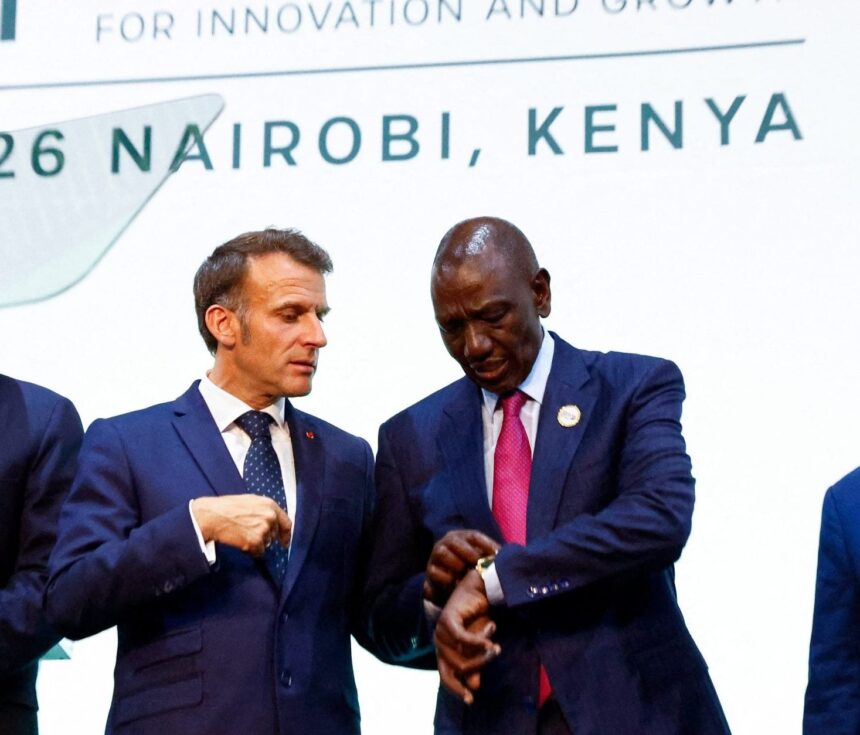
More than half of Africa’s presidents gathered in Nairobi this week for the Africa Forward summit hosted by French President Emmanuel Macron, but South Africa’s absence stood out as France sought to deepen ties beyond its traditional francophone allies. Over 30 African leaders attended the summit, which signalled France’s strategic shift toward broader engagement with both francophone and anglophone nations following strained relations with several former French-speaking partners.
Speaking on the sidelines of the event, France’s Minister for Francophonie, International Partnerships and French Nationals Abroad, Éléonore Caroit, said the summit reflected France’s intention to engage with the entire continent. Macron used the platform to announce investment commitments worth €23bn ($27bn) for Africa. The summit was framed as a partnership of equals, with Kenyan President William Ruto stressing that sustainable cooperation should be built on sovereign equality and mutual economic benefit rather than dependency or aid.
Leaders from several of Africa’s largest and fastest-growing economies, including Nigeria, Ghana, Senegal, Egypt, Ethiopia and host nation Kenya, were present. However, there was no official South African delegation.South African President Cyril Ramaphosa’s office had initially cited scheduling constraints for his absence, while Minister in the Presidency Maropene Ramokgopa also withdrew from attending just days before the summit without publicly explaining the decision.
Sources close to the presidency indicated that Ramaphosa had been occupied with urgent domestic consultations following a court ruling that revived parliamentary scrutiny over the Phala Phala scandal, which centres on the alleged concealment of the theft of about $580,000 from his game farm in 2020.Some government insiders also suggested Pretoria viewed the summit with caution, objecting to the optics of one country appearing to convene the continent and expressing concerns over broader geopolitical positioning.
There was also speculation that tensions may have been heightened by Macron’s decision to withdraw an earlier invitation for Ramaphosa to attend the upcoming G7 summit in France, reportedly after objections from the United States.Diplomatic tensions have also grown amid concerns over anti-immigrant protests in South Africa, with misinformation and reports of attacks on foreign nationals fuelling unease across the continent.
In Ramaphosa’s absence, Nigerian President Bola Tinubu used his address at the summit’s peace and security session to speak against violence targeting migrants, stressing that migration should not be criminalised and calling for stronger regional cooperation. South African officials have since sought to reassure African partners, with Ramaphosa stating that recent anti-foreigner violence does not reflect government policy or the views of most South Africans.
French officials have denied any political fallout behind South Africa’s absence. Caroit insisted there was no diplomatic dispute, emphasising that France remains committed to strong bilateral relations with Pretoria. Political analyst Sanusha Naidu argued that summit attendance should not be overinterpreted, noting that the real substance of diplomacy often happens behind closed doors long before such events take place.She also warned African countries against viewing France through the lens of friendship, stressing that international relations are ultimately driven by strategic interests.
Independent analyst Marisa Lourenço suggested domestic political pressures likely played the biggest role in South Africa’s absence, though she noted it was inconsistent for Pretoria to criticise another country convening African leaders after branding its own G20 hosting efforts as “Africa’s G20.” Meanwhile, analysts remain sceptical about the practical impact of Macron’s latest investment promises.
Africa analyst Carlos Lopes questioned whether France’s pledges would translate into measurable outcomes, noting that previous financial commitments announced by Macron have yet to produce visible results on the continent.
Source: https://www.theafricareport.com/