



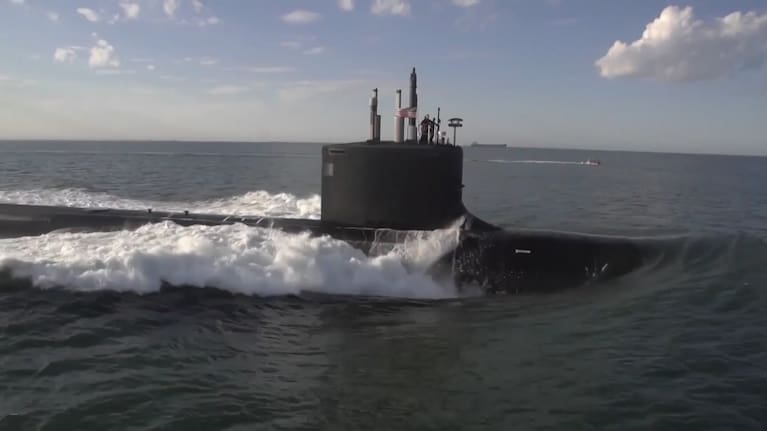
China has test-fired a strategic missile carrying a dummy warhead into the Pacific Ocean from a submarine, prompting condemnation from several countries in the region over growing security concerns. The launch took place on Monday, the same day Australia and Fiji signed a major defence treaty aimed at strengthening security cooperation in the strategically important South Pacific.
While New Zealand described the weapon as a nuclear-capable long-range ballistic missile, China’s defence and foreign ministries did not confirm whether an intercontinental ballistic missile (ICBM) was used. The test comes two years after China launched an ICBM into international waters near French Polynesia, marking its first such launch in more than four decades.
According to the Chinese navy, the missile was launched from a nuclear submarine during routine annual military training and accurately reached its designated target area. Naval analyst Alex Luck suggested the missile may have been the JL-3 submarine-launched ballistic missile, although he noted that the older JL-2 variant could also have been used. China said relevant countries were notified in advance, though New Zealand’s Foreign Minister Winston Peters said his country received notice only hours before the launch.
Peters described the Pacific as an “Ocean of Peace” and said the missile test was inconsistent with regional stability. Australia also labelled the launch destabilising, while Japan expressed serious concern over China’s expanding military activities. Responding to the criticism, China’s foreign ministry insisted the launch was not directed at any country and urged governments not to overinterpret the exercise, describing it as safe, professional and routine.
The missile test came as China commenced annual joint naval exercises with Russia off the eastern port city of Qingdao. The drills include joint reconnaissance, air and missile defence exercises, tactical coordination and live weapons training. Papua New Guinea’s Foreign Minister Justin Tkatchenko confirmed that China had informed his government ahead of the launch, while New Zealand warned that similar missile tests could become a recurring feature of the Pacific.
The latest development comes amid China’s continued expansion of its nuclear capabilities. According to the Pentagon, Beijing possessed more than 500 operational nuclear warheads as of May 2023 and is projected to exceed 1,000 by 2030.Military analysts say China’s modernisation of its nuclear-powered submarine fleet is likely to result in more frequent missile tests in the coming years.
The launch has also revived concerns across Pacific island nations, many of which continue to bear the legacy of nuclear testing conducted by the United States, Britain and France after World War II, even as China expands its influence across the region through major infrastructure and development projects.
Source: https://punchng.com/