



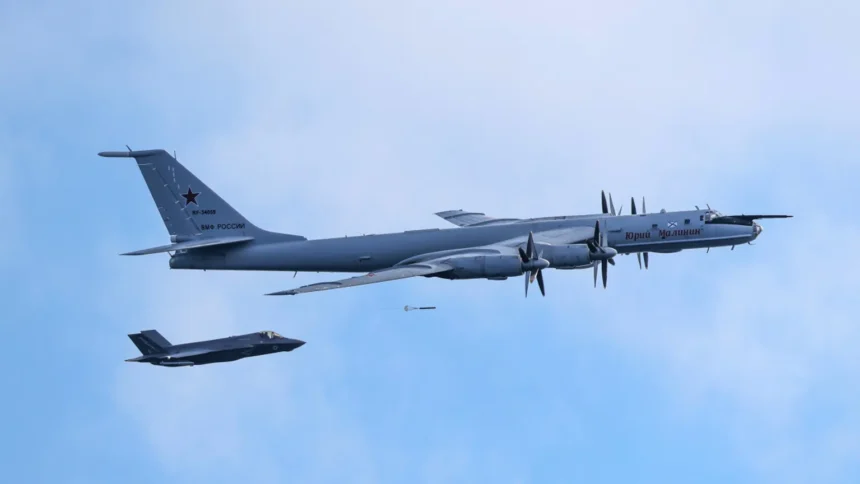
UK fighter jets intercepted a Russian maritime patrol aircraft after it repeatedly approached a NATO carrier strike group operating in the Norwegian Sea, the Ministry of Defence (MoD) has said. According to the MoD, the Russian Bear-F aircraft flew at low altitude and passed unnecessarily close to the aircraft carrier HMS Prince of Wales before reportedly dropping 10 sonobuoys into the water during Thursday’s encounter.
British officials described the Russian aircraft’s actions as unsafe and unprofessional. The incident comes weeks after Royal Marines boarded a Russian shadow fleet oil tanker in the English Channel, amid heightened tensions between Russia and NATO. The UK’s Carrier Strike Group, currently operating under NATO command off Iceland, includes HMS Prince of Wales, the Type 45 destroyer HMS Duncan, F-35 fighter jets, Merlin and Wildcat helicopters, and the replenishment tanker RFA Tidespring, with around 1,500 British personnel deployed.
It also marks the first time NATO has conducted air policing operations from a European aircraft carrier. The sonobuoys reportedly released by the Russian aircraft are floating monitoring devices equipped with sonar systems used to detect submarines and other underwater vessels. The MoD said British forces attempted to contact the Russian aircraft using international radio frequencies but received no response, prompting two F-35 fighter jets to scramble from HMS Prince of Wales and escort the aircraft away from the strike group.
Defence Secretary Dan Jarvis, who visited the carrier over the weekend, said the deployment strengthens NATO’s deterrence and defence capabilities at a time of increasing global security challenges. He warned that Russia poses threats across multiple domains, including land, sea, air, cyberspace and space. The incident follows recent comments by Chief of the Defence Staff Sir Richard Knighton, who said Russia has been testing the UK’s defences and increasing the risk of confrontation.
NATO has previously warned that Russia could be in a position to use military force against the alliance by 2030. The interception also comes after the UK government unveiled a £15 billion increase in defence spending as part of its updated defence investment strategy, although opposition politicians and military figures argue the funding remains insufficient to address the growing threat from Russia. Meanwhile, the UK government announced sanctions against seven individuals and two organisations linked to the development of the chemical weapons used in the 2018 Salisbury Novichok attack that killed Dawn Sturgess and the poisoning of Russian opposition leader Alexei Navalny in 2024.
Source: https://www.bbc.com/