




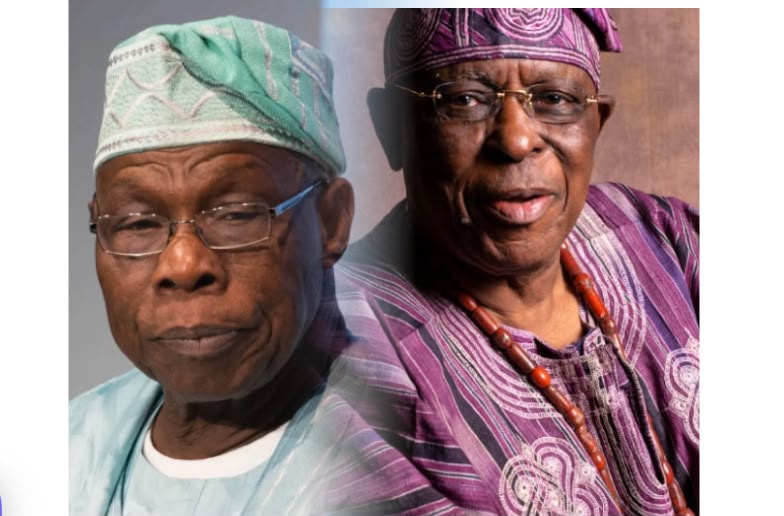
Former President Olusegun Obasanjo, in a letter written to former Ogun State Governor Segun Osoba, dismissed Osoba’s publication titled “How Obasanjo Deceived Us in 2003” as inaccurate, maintaining that he has never misled anyone throughout his political journey. He noted that several crucial events surrounding his rise to the presidency and subsequent political moves were either unknown to Osoba or left out of the article.
The former president explained that his entry into politics came after extensive consultations following repeated calls from leaders nationwide after his release from prison. He stated that he met with key figures across the South-West, North, and South-East before making the decision to join the Peoples Democratic Party (PDP) and run for president. Obasanjo added that his core political philosophy has always centered on fostering dialogue, building relationships, and promoting national unity rather than encouraging division or ethnic politics.
He further maintained that his choice to form an inclusive government following the 1999 elections stemmed from a commitment to national interest rather than political vulnerability.When Nigeria returned to civil rule in 1999, the Alliance for Democracy (AD)—backed by the influential Yoruba socio-cultural group Afenifere—held sway in the South-West. The party swept the governorship elections across all six states in the region: Ogun, Ondo, Ekiti, Osun, Lagos, and Oyo. However, the party lost its dominant grip on the region just four years later, yielding five of those six states to the PDP during the 2003 governorship polls. Osoba lost his re-election bid in Ogun State, while fellow AD governors Adebayo Adefarati (Ondo), Lam Adesina (Oyo), Bisi Akande (Osun), and Adeniyi Adebayo (Ekiti) also suffered defeat. Only Bola Tinubu of Lagos State secured a second term among the region’s AD governors.
Popular political accounts blamed the AD’s losses on a flawed, informal understanding reached with Obasanjo ahead of the 2003 general elections. Under this unwritten arrangement, the AD governors agreed to support Obasanjo’s presidential bid, while Obasanjo was expected to support their return to office on the AD platform. Tinubu, however, distanced himself from the pact, campaigning vigorously against Obasanjo and the PDP while urging Lagos voters to vote exclusively for the AD.
The remaining five AD governors honored their part of the arrangement, but Obasanjo allegedly failed to uphold his end. The five governors were defeated, allowing the PDP to gain control of those states, while Tinubu—who refrained from joining the agreement—emerged as the sole surviving AD governor to complete a second term. Rebutting these claims, Obasanjo rejected suggestions that he depended on the six AD governors to navigate political challenges, calling such assertions unrealistic given the PDP’s numerical dominance. He also dismissed allegations that he agreed to political terms presented by Afenifere leaders before taking office, asserting that no group dictated his administration’s decisions.
Defending the 2003 election outcomes, Obasanjo argued that the defeats faced by most AD governors were the result of campaign shortcomings and changing political realities rather than electoral manipulation. He faulted Afenifere for engaging in narrow regional politics, stressing that governing a diverse nation requires a broader, more inclusive political approach.Reflecting on his past relationships, Obasanjo expressed sympathy for late Afenifere leaders who passed away holding regrets, including Chief Gani Daudu, Chief Abraham Adesanya, and Chief Ayo Adebanjo, noting that the principles they stood for were later abandoned by their successors.
Addressing Osoba directly, Obasanjo highlighted numerous inaccuracies and omissions in the article published in The Legal Observer, describing its premises as farfetched. He strongly objected to being labeled a deceiver, insisting that he has always conducted his political affairs transparently regardless of whose interests were affected. Despite their sharp differences, Obasanjo acknowledged Osoba’s contributions to Ogun State, particularly highlighting his role in allocating land for the Olusegun Obasanjo Presidential Library in Abeokuta. He concluded by urging political figures to maintain humility and preserve personal friendships, emphasizing that political competition should never undermine human relationships or national progress.
Meanwhile, reports noted that one of the primary points raised in Osoba’s article was the AD’s decision to endorse Obasanjo in the 2003 presidential election. Osoba contended that Obasanjo was well aware he would not run under the AD banner, yet allowed the party to endorse him under false pretenses. Osoba recalled that despite pushback from some Afenifere leaders, the party chose not to field a presidential candidate, only to later realize they had been misled by promises that were never sincere.
Source: https://www.premiumtimesng.com/