



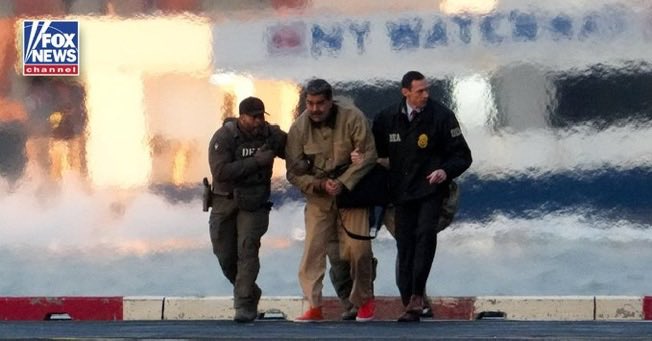
Maduro, 63, is facing narcotrafficking charges alongside his wife, Cilia Flores.The couple were forcibly removed from Caracas during a U.S. military operation on Saturday, which involved commandos deploying from helicopters with support from fighter jets and naval forces.On Monday morning, Maduro was escorted by heavily armed law enforcement officers to a courthouse in New York after being transported by helicopter and armoured vehicle.
Attention is now focused on Venezuela’s response to the rapidly unfolding events. Late on Sunday, interim leader Delcy Rodríguez appeared to soften her earlier defiance, offering to work with U.S. President Donald Trump.“We extend an invitation to the U.S. government to work together on an agenda for cooperation,” the former vice president said. On Sunday, about 2,000 supporters of Maduro, including armed men riding motorcycles, rallied in Caracas, chanting slogans and waving Venezuelan flags. The Venezuelan military, which has remained loyal to Maduro, announced it recognised Rodríguez as interim leader and called for calm.
No official death toll has been released, but Defence Minister Vladimir Padrino López said a “large part” of Maduro’s security detail was killed “in cold blood,” along with military personnel and civilians. Trump said late Sunday that the United States was now “in charge” of the South American nation, while U.S. Secretary of State Marco Rubio described discussions about elections in Venezuela as “premature.” Asked what he required from Rodríguez, Trump said: “We need total access. We need access to the oil and other things in their country that allow us to rebuild their country.”
Venezuela holds the world’s largest proven oil reserves, and an increase in its crude supply could worsen global oversupply concerns and add pressure on prices. Analysts, however, say significantly boosting production would be difficult, costly and time-consuming. Oil prices dipped as investors assessed the potential impact of developments in Venezuela. The Trump administration has said it retains economic leverage by blocking Venezuelan oil tankers, while Trump has also threatened further military action.
Although no U.S. ground forces are believed to be operating inside Venezuela, a significant U.S. naval presence, including an aircraft carrier, remains stationed offshore.Prominent opposition figure Edmundo González Urrutia said the U.S. intervention was “important” but insisted it was “not enough” without the release of political prisoners and recognition of his claimed victory in the 2024 election. Details of the U.S. operation were still emerging on Monday. Cuba said 32 of its nationals were killed in the attack, while Trump claimed Cuba itself was close to collapse following Maduro’s capture. “I don’t think we need any action. It looks like it’s going down,” Trump said.
At Venezuela’s request, the United Nations Security Council is scheduled to hold an emergency session on Monday. The White House said it does not seek regime change, only Maduro’s removal and the installation of a cooperative government, even if it includes some of his former allies. Handpicked by Hugo Chávez before his death in 2013, Maduro maintained a tight grip on power until his capture on Saturday. He ruled alongside Flores and three influential figures: Rodríguez, now interim leader; her brother Jorge Rodríguez; and their rival, hardline Interior Minister Diosdado Cabello. “It’s like a club of five,” a diplomatic source in Caracas told AFP, speaking anonymously.
The U.S. stance has left Venezuela’s opposition sidelined, despite Washington’s claims that Maduro stole the last election. China, Russia and Iran, all close allies of Maduro’s government, swiftly condemned the operation. Some U.S. allies, including the European Union, also expressed concern. China called for Maduro’s “immediate release,” describing the U.S. action as a “clear violation of international law.” Iran said on Monday that its relationship with Venezuela remained unchanged and also demanded Maduro’s release. Colombian President Gustavo Petro described the U.S. operation as an “assault on the sovereignty” of Latin America and warned it could trigger a humanitarian crisis. Petro also rejected Trump’s threats of military action against Colombia and dismissed accusations by the U.S. president linking him to drug trafficking.