



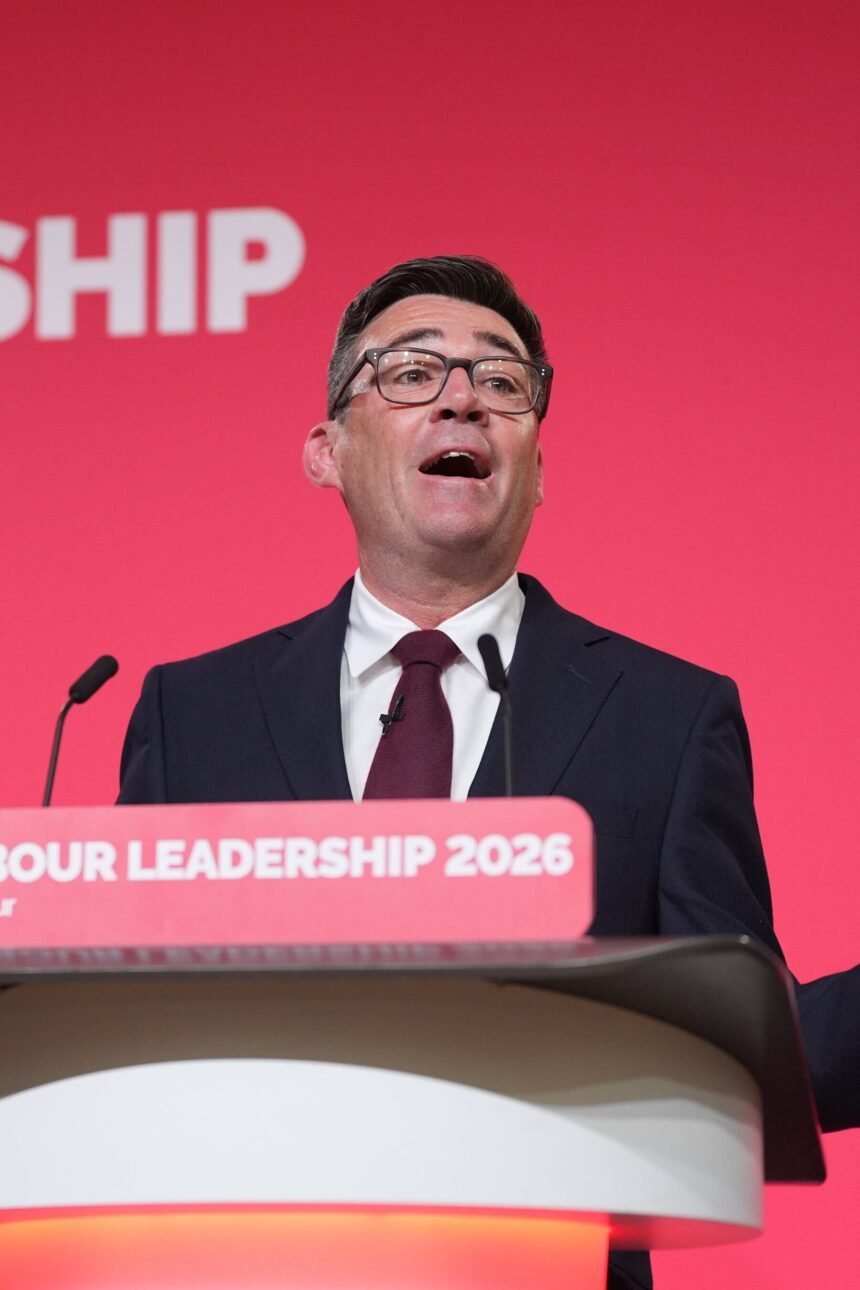
Andy Burnham has declared that he is fully prepared to confront Britain’s new right with a fresh, collaborative vision as he steps up to lead the Labour Party ahead of officially becoming the British prime minister on Monday. The former Greater Manchester mayor secured dominant backing from members of Parliament, major trade unions, and local party branches, positioning him as the clear choice to succeed Keir Starmer. Burnham’s leadership was formally announced on Friday during a special party gathering at the Trades Union Congress headquarters in London. The declaration was delivered by Shabana Mahmood, the current chair of the party’s ruling executive and the leading candidate to serve as his chancellor.
Speaking to an audience of prominent Labour politicians and loyal backers, Burnham noted that the nation is eagerly searching for a new style of politics. However, he emphasized that this moment represents Labour’s absolute final opportunity to evolve, urging the party to move forward together as a single, unified front. He expressed deep gratitude, describing the occasion as an emotional and proud moment for his family, while making it clear he is ready to build directly upon the foundations established by Starmer, who guided the party from its lowest point to a historic electoral victory.
Burnham stated that Labour has achieved true solidarity, promising to direct that collective strength toward helping communities and individuals who have been neglected by the political system for far too long. While honoring Starmer’s contributions, the incoming leader signaled a definitive shift forward by challenging the party to evaluate whether its past efforts had truly been sufficient, promising a commitment to doing even better. He pledged to focus intensely on fostering a shared team culture across the party, warning that infighting and internal divisions are counterproductive distractions that will prevent them from defeating the right-wing opposition.
Though comprehensive policy manifestos have yet to be published, Burnham outlined his core initial priorities, which focus on transferring greater decision-making power to local communities, maintaining a strong pro-business stance, and expanding the construction of social and council housing. The transition will culminate on Monday, when Starmer is scheduled to visit Buckingham Palace to tender his formal resignation, clearing the path for Burnham to officially assume the role of prime minister. Following the handover, Burnham will deliver an address outside 10 Downing Street before spending the afternoon finalizing his cabinet selections, though he maintained on Friday that his top team has not yet been formally locked in.
The new leader promised to map out a highly distinct path for Labour while remaining open to cross-party collaboration. He openly dismissed the strategy of mimicking Conservative policies, trying to outpace Reform UK, or attempting to match the platform of the Green Party. Instead, he expressed a desire for the public to clearly understand the philosophy behind his platform, arguing that too much governance has been concentrated in Westminster or outsourced to corporate entities.
Responding to critiques that his time as mayor left him overly focused on northern interests, Burnham countered that he intends to govern equitably for every region, including the north, south, east, and west, as well as Scotland, Wales, and Northern Ireland. He described the transition as an opportunity to unify the entire country under a shared purpose, expressing an appreciation for the nation’s diverse regional accents, heritages, and sporting rivalries.
Ultimately, he reiterated his promise to strip administrative control away from central government offices in Whitehall and Westminster, returning that power directly to local neighborhoods. Burnham concluded his address by honoring several iconic figures within his party, offering specific thanks to David Blunkett and Neil Kinnock for guiding his early career and serving as long-term inspirations for his political journey.
Source: https://www.theguardian.com/