



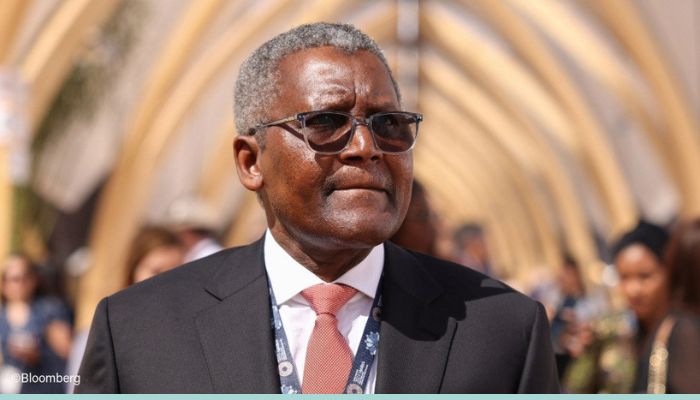
Aliko Dangote, the business magnate behind Africa’s largest industrial conglomerate, has announced plans to enter Nigeria’s struggling power sector with an ambitious target of generating 20,000 megawatts of electricity. The proposal comes as Nigeria continues to face long-standing electricity shortages that have slowed industrial growth and increased reliance on costly alternative power sources.
The announcement was made during a discussion with Makhtar Diop, where Dangote described energy as one of Africa’s most urgent development needs, alongside fertiliser and industrial inputs. “We are now going into power… 20,000 megawatts,” he said. Dangote, who recently commissioned a 650,000-barrel-per-day refinery and strengthened his position in the fertiliser industry, said his group now has the financial capacity and operational strength to expand into large-scale electricity generation. He added that his businesses are increasingly structured to generate strong cash flow needed for capital-intensive projects of this scale.
His move into the power sector follows years of unmet electricity targets by government authorities. Nigeria’s power output has frequently fallen far below demand, with supply often fluctuating around 3,000 megawatts despite repeated promises of improvement.Former power sector officials, including Adebayo Adelabu, have faced challenges meeting generation benchmarks, with several targets for grid stability remaining unfulfilled.
The country’s unstable electricity supply has continued to affect economic productivity, forcing many households and businesses to rely on diesel generators for daily operations. According to global financial estimates, poor electricity supply costs the Nigerian economy tens of billions of dollars annually, representing a significant drag on national output. Although Nigeria briefly recorded higher generation levels in recent years, including occasional peaks above 6,000 megawatts, these gains have not been sustained due to infrastructure limitations and gas supply constraints.
Despite Dangote’s reputation for executing large industrial projects, analysts say the proposed 20,000MW plan faces major structural challenges, including an overstretched transmission network that may not be able to evacuate generated power efficiently. The sector also continues to struggle with liquidity issues, as electricity distribution companies face difficulties recovering revenue, leading to unpaid debts within the energy value chain.
Dangote’s broader strategy appears to focus on vertical integration, combining energy production with his investments in fertiliser, mining, logistics and industrial infrastructure. He has previously highlighted plans to expand fertiliser production capacity significantly while investing in mining operations and building large-scale logistics infrastructure to support industrial output. However, experts note that implementing a project of this magnitude would require extensive policy reforms, strong regulatory support and major upgrades to Nigeria’s national grid system. For now, the proposal has sparked discussion about the role of private sector investment in addressing Nigeria’s long-standing electricity challenges.
Source: https://businessday.ng/